6 sq ft · 1.2× benchmark
Fits beside or above the backboard and meets Antrim's sign-permit exemption. Placement and assembly rules are covered below.
❯ Town Line Recycling Project Plan
Concerned neighbors proposed a simple fix for roadside litter: a town-line recycling target that gives cans somewhere better to land than New Hampshire’s scenery. The idea pairs a basketball backboard with a catch net and recycling barrel. The sign and message are designed; measurements, placement, and the build come next.
❯ Execution path
The purpose, message, and artwork are settled. Next: measure the site, confirm the Antrim-side placement, and design the support and catch system.
Collect beverage cans in a purpose-built receptacle to reduce roadside litter. The intended user is in a safely stopped vehicle, with missed cans contained away from traffic.
The landowner approved the current wording and symbols after considering how the green check beside “Drinking and driving” could read as endorsing impaired driving or disposal of evidence. The selected files reflect that decision; outside review remains optional.
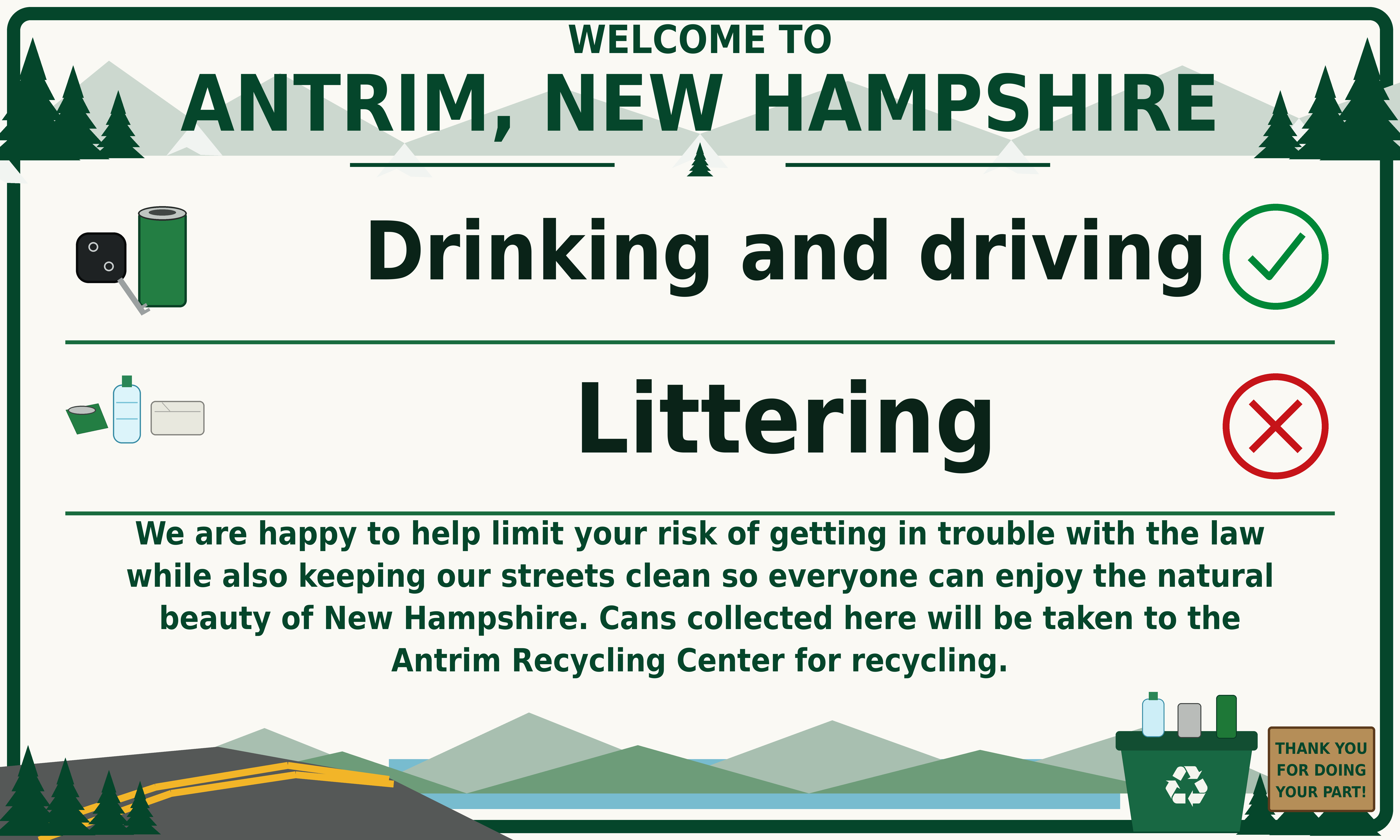
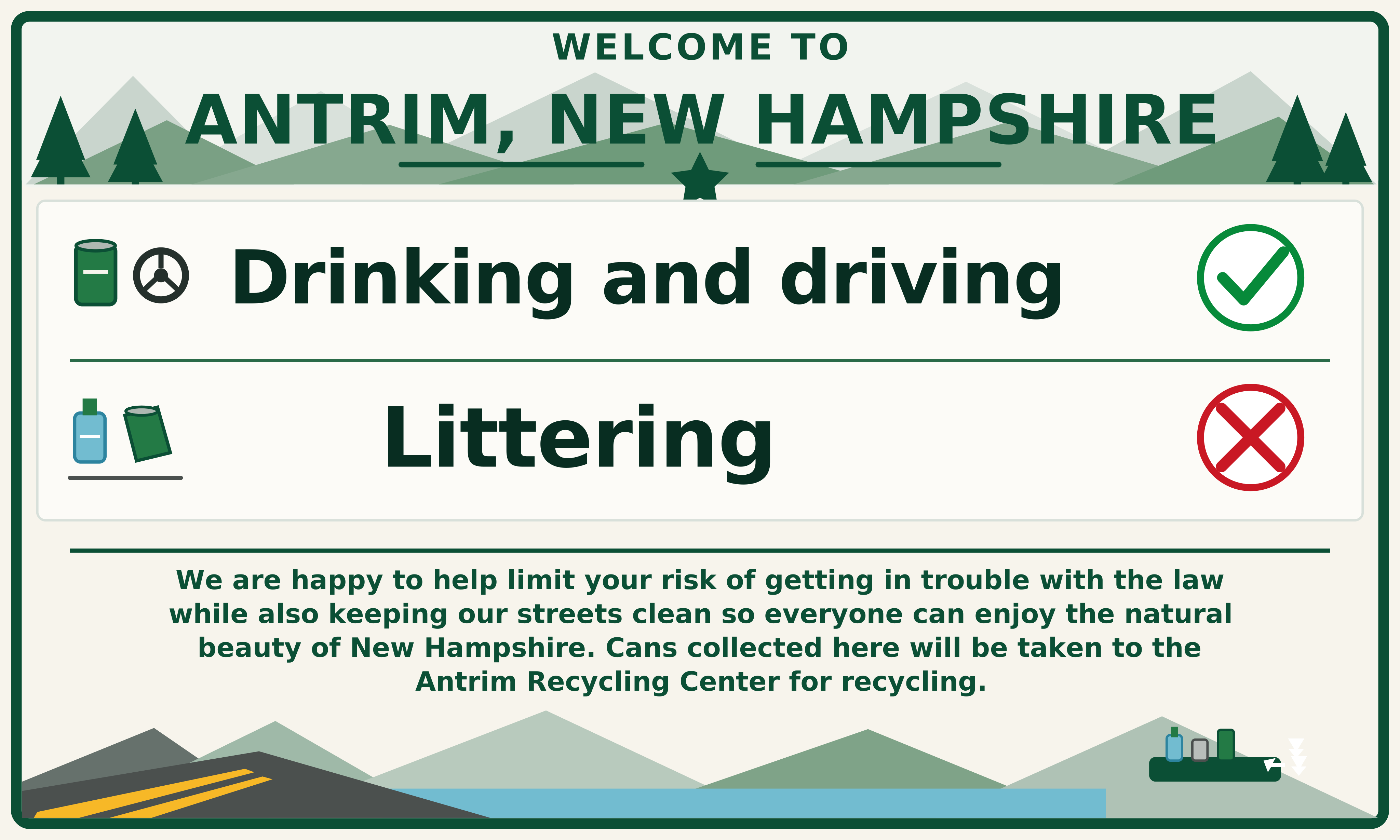
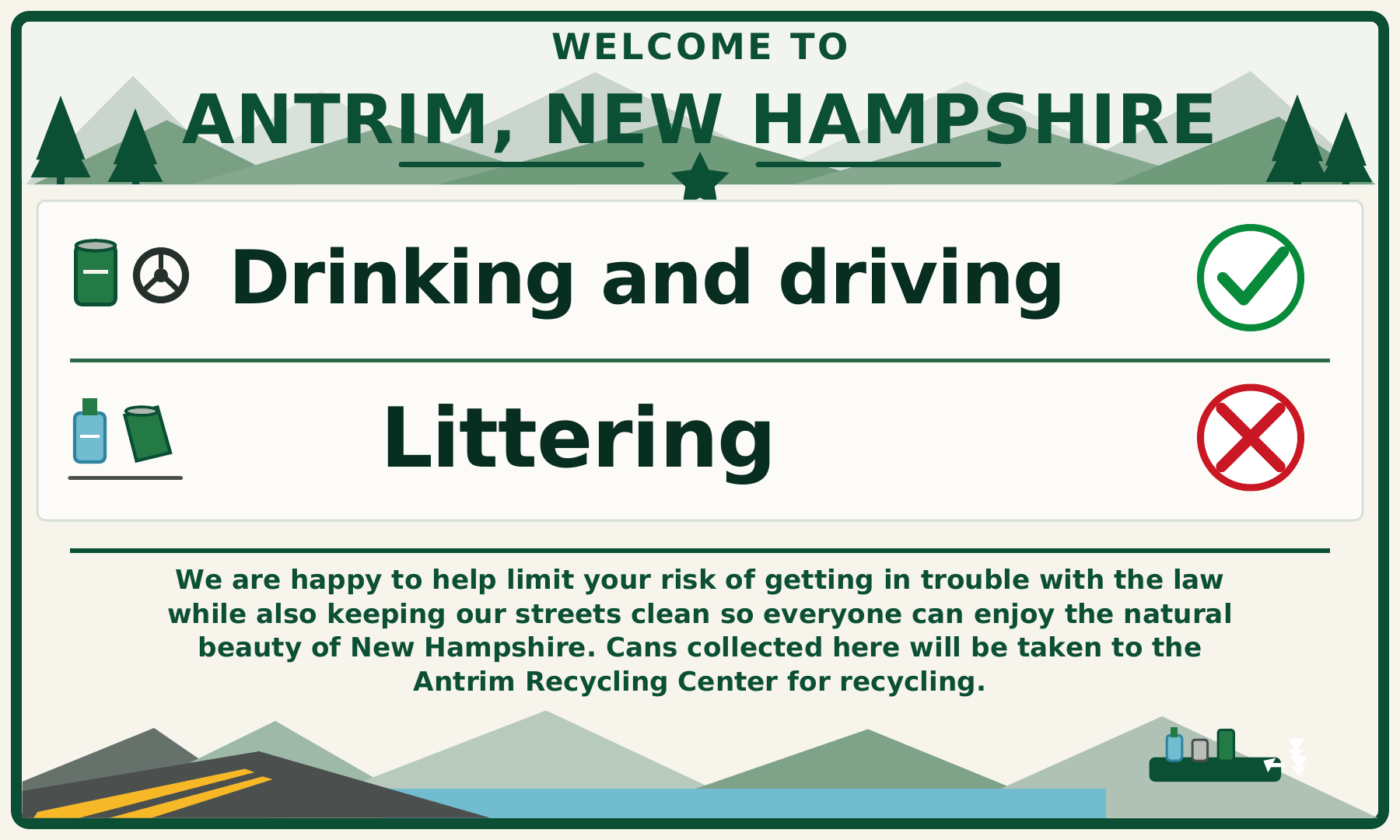
The selected sign is 24 × 36 inches: six square feet, portrait format, with editable DejaVu Sans text. The matching print PDF has an exact trim box, vector geometry, embedded fonts, and searchable text. The 150-ppi PNG is available for full-resolution review.
Compact option selected
The larger sizes remain as reference alternatives.
Benchmark: the FHWA's conventional R2-1 speed-limit sign is 24 × 30 inches, or 5 square feet. The recycling sign should use its own green visual language and must not imitate an official traffic-control sign.
Two workable mounting arrangements
Choose after checking sight lines and wind loads. Both use the backboard's support frame, with an independent sign crossbar and barrel restraint. Sign fasteners must load the support rather than the backboard panel; leave access for emptying and cleaning the barrel.
Next: choose the backboard model and mounting arrangement, verify the factory mount, and confirm printer requirements.
The landowner owns both parcels at 10 Old Hancock Road; landowner permission is settled. Old Hancock Road is an Antrim scenic town road, so the selected private-property path does not need NHDOT sign approval. Field boundaries and the support still need checking.
RSA 664:17 allows political advertising in a state-owned right-of-way with underlying landowner consent and safe traffic clearance, subject to removal deadlines and attachment restrictions. That exception does not extend to this recycling sign; the plan uses Antrim's ordinary private-property sign rules.
Read RSA 664:17 ↗Planning basis: a six-square-foot sign wholly inside Antrim, outside the right-of-way, on an adequate lawful support. The remaining zoning question concerns the complete permanent assembly.
Next: mark both boundaries, record the Antrim-side offset and roadside clearances, and resolve the assembly classification as needed.
The current geometry is a concept based on a roughly 35-inch barrel rim. Select the actual commercial basketball backboard and replace every assumption with its manufacturer drawing plus field measurements before making brackets. Photograph the existing support, connections, and surrounding grade so the design can be checked against the site.
Open the real-backboard installation mockup ↗
Ready when: measurements, site photos, and component specifications are collected.
Draw dimensioned front, side, plan, and attachment details using the measured site and backboard manual. Verify that the support carries the backboard, rim, sign, wind, and impact loads without relying on the barrel shell. Check existing posts, footings, welds, brackets, and fasteners against those loads. Specify factory mounting points, corrosion protection, tamper-resistant hardware, rounded edges, and a tapered net or enclosed funnel to contain misses and rebounds.
Ready when: bracket and load drawings establish an adequate existing support, or a replacement design is ready for Antrim's classification before construction.
Build the backboard mount, independent sign crossbar, barrel restraint, and catch net from the final drawings. Deburr every cut, cap open posts, protect all exposed steel, and verify that no bolt, edge, or brace projects toward users. Load-test the assembly before attaching the printed sign.
Ready when: the build matches the drawing, fastener torque is recorded, and the restraint and static load checks pass.
Start with a stationary vehicle in a closed, off-road test area. Use empty clean cans, sober participants, a spotter, no bystanders, and a catch system that contains every miss. Record release position, success rate, rebounds, and failure modes. Do not perform moving-vehicle trials on an open public road.
Ready when: stationary tests show predictable containment and the operating plan addresses observed failures before broader use.
After placement, support, and containment checks pass, send the compact PDF to print. Check the smaller explanatory text at the intended viewing distance. Confirm substrate, UV laminate, edge sealing, mounting holes, and whether the printer needs bleed or crop marks. Print at 100% to preserve the selected dimensions. Install at the measured location and photograph the boundary clearances, factory-frame attachments, barrel restraint, and finished assembly.
For a new permanent frame, obtain Antrim's classification and any required permits before construction. Call Dig Safe before excavation.
Ready when: installation photos and measurements are saved with the support details and any required municipal determination.
The landowner handles emptying, contamination, cleaning, winter closure, fastener and corrosion checks, and complaints. Set a regular schedule to review missed cans, traffic behavior, and collection volume; close or remove the installation if it becomes unsafe. Keep maintenance access clear and check that the catch net, barrel restraint, and sign remain secure after storms or impacts.
Keep: a maintenance schedule and log, contact sign, and clear closure or removal criteria.
! Before fabrication
Message and artwork are approved. These checks cover the remaining field, design, and testing work.
Replace concept dimensions with the actual barrel, support, ground conditions, and selected backboard's factory drawing.
Measurement checklist ↗Mark the town line and recorded right-of-way. Confirm the whole assembly fits inside Antrim with the roadside clearances listed in step 04.
Antrim 2026 ordinance ↗ Hancock 2025 ordinance ↗Verify factory connections and support capacity. Obtain Antrim's classification before building any new permanent frame.
Structural design notes ↗Contain every miss and avoid driver distraction, stopping in a travel lane, sight-line obstruction, and pedestrian exposure.
NH roadside litter law ↗❯ Project files
The review images stay light enough for a phone. The originals behind these links retain their full resolution or vector geometry.